
RERA Registration
RERA (Real Estate Regulatory Authority), introduced under the Real Estate (Regulation and Development) Act, 2016, was established to bring transparency, accountability, and efficiency to India’s real estate sector. Before its implementation, homebuyers often faced issues like project delays, hidden charges, misuse of funds, and lack of clear information from builders. RERA made it mandatory for developers and real estate agents to register their projects before selling or advertising, ensuring that all project details such as timelines, approvals, and costs are clearly disclosed. It also requires builders to keep 70% of buyers’ funds in a separate account to prevent misuse. Additionally, RERA provides a fast-track dispute resolution system and holds all parties legally accountable. Overall, RERA has significantly improved trust and security in real estate transactions, protecting buyers while promoting fair and professional practices in the industry.

Hallmark Registration
Hallmark Registration is an official certification provided by the Bureau of Indian Standards (BIS) that authorizes jewelers to sell hallmarked gold and silver jewellery. This certification ensures that the purity and quality of the precious metal meet the standards set by BIS. Every hallmarked jewellery item includes three key details: the BIS logo, a purity mark (like 22K/916), and a unique 6-digit alphanumeric HUID code for identification and traceability.
This system helps build strong customer trust, prevents fraud in gold purity, promotes ethical business practices, and ensures better resale value for jewellery. In India, hallmarking has been made mandatory for gold jewellery, making hallmark registration essential for jewelers to operate legally and maintain credibility in the market.

FPO Mark Certification
The FPO (Food Products Order) Mark, introduced in 1955, is a certification that ensures processed fruit and vegetable products in India meet proper safety, hygiene, and quality standards. Earlier, it was a separate mandatory certification, but now it has been integrated under the Food Safety and Standards Authority of India (FSSAI) licensing system. This means that businesses must obtain an FSSAI license and comply with FPO-level standards to legally manufacture and sell such products.
To use the FPO mark, manufacturers must follow strict guidelines related to clean production facilities, use of safe ingredients, proper labeling, and regular quality testing through approved laboratories. The process includes document submission, inspection by authorities, and product testing before approval is granted.
Overall, the FPO mark helps ensure food safety, builds consumer trust, supports legal compliance, enhances brand value, and allows businesses to expand in both domestic and export markets.
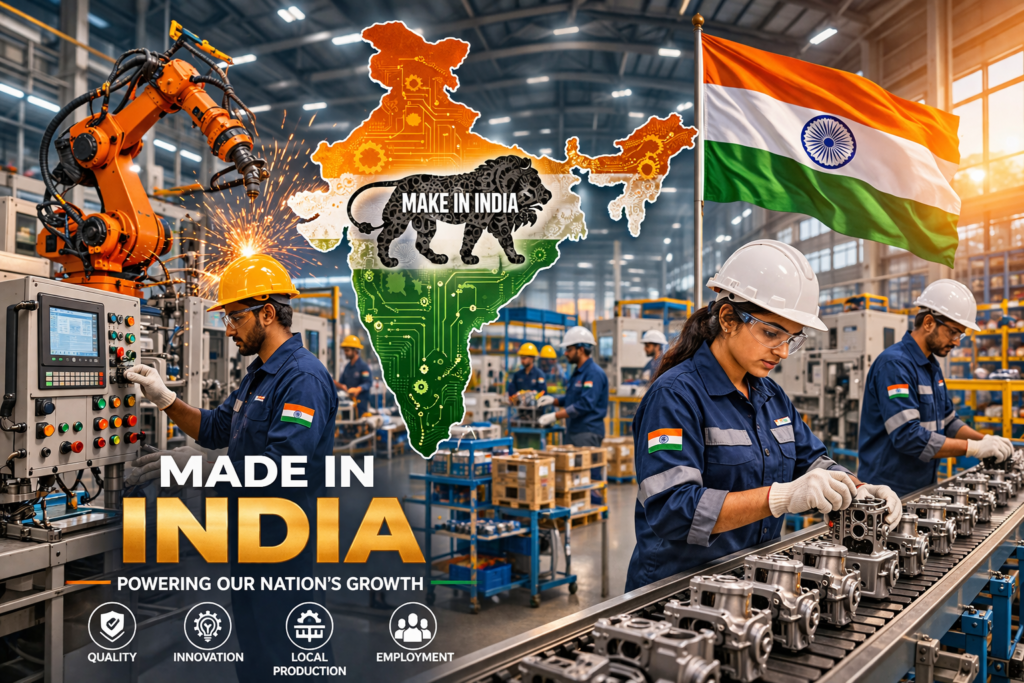
Make in India Certificate
The Make in India Certificate is not a direct government-issued certificate but a self-declaration or third-party verified document under the Public Procurement (Preference to Make in India) policy, introduced as part of the Make in India initiative by the Government of India. It certifies that a product is manufactured or produced in India based on its local content percentage, which includes the value of Indian raw materials, labour, services, and manufacturing processes involved.
This certification is especially important for businesses that want to participate in government tenders or supply to public sector organizations, as preference is given to local suppliers—particularly those with higher Indian content. It also helps companies strengthen their brand image, build trust among customers, and demonstrate their contribution to the “Atmanirbhar Bharat” mission. Overall, the Make in India Certificate acts as proof of local manufacturing, giving businesses a competitive advantage in both government and private markets while supporting India’s economic growth.

NGO Project Report
An NGO Project Report is a comprehensive formal document that provides a complete overview of a project carried out by a Non-Governmental Organization (NGO). It clearly explains the project’s purpose, background, and the problem it aims to address, along with defined goals and measurable objectives. The report outlines all key activities, implementation methods, timelines, and resources used during the project.
It also includes a detailed financial summary, showing how funds were allocated and utilized, ensuring transparency and accountability. In addition, the report highlights the results achieved, the overall impact on the target community, and any challenges faced during execution. It may also include monitoring and evaluation data to measure the project’s effectiveness.
This report acts as an essential communication tool for donors, CSR partners, government authorities, and stakeholders, helping them understand the project’s success, build trust, and support future initiatives.

TEXPROCIL Registration
TEXPROCIL Registration is the process through which exporters become members of the The Cotton Textiles Export Promotion Council, an official body established to promote cotton textile exports from India. It operates under the Ministry of Textiles and helps businesses expand globally by providing export support, market insights, and international exposure.
After successful registration, exporters receive a Registration Cum Membership Certificate (RCMC), issued digitally through the Directorate General of Foreign Trade portal. This certificate is essential to avail benefits under India’s Foreign Trade Policy (FTP), such as export incentives, duty refunds, and participation in global trade events. Overall, TEXPROCIL registration enhances credibility, ensures compliance, and supports the growth of cotton textile exporters in international markets.

NSIC Registration
NSIC Registration (National Small Industries Corporation) is a Government of India certification designed to support Micro and Small Enterprises (MSMEs) in growing their business.
It is issued under the Single Point Registration Scheme (SPRS), which allows eligible businesses to participate in government tenders more easily. NSIC-registered units get key benefits such as free tender documents, exemption from Earnest Money Deposit (EMD), and price preference, increasing their chances of winning government contracts.
In addition, NSIC provides financial assistance (loans and raw material support), marketing help, and technology support to strengthen small businesses.

Rubber Board Registration
Rubber Board License Registration (Rubber Board of India) is an official government authorization required for individuals and businesses involved in activities related to natural rubber in India.
It is issued under the Rubber Act, 1947, which regulates the production, processing, trading, and distribution of rubber. This makes the license mandatory for entities such as rubber growers, processors, manufacturers, traders, and exporters.
Having this license ensures your business is legally compliant, allows you to buy, sell, process, or export rubber without restrictions, and helps you avoid penalties or legal action. It also enables access to government subsidies, financial support schemes, and market assistance provided by the Rubber Board.

Spice Board Registration
Spice Board Registration (Spices Board of India), officially known as CRES (Certificate of Registration as Exporter of Spices), is a mandatory license for any business in India that wants to export spices. It is issued under the Spices Board Act, 1986, which regulates the development, quality, and export of spices from India. This registration ensures that exporters follow strict quality standards, food safety guidelines, and international trade regulations, helping maintain India’s reputation in the global spice market.
To apply, businesses must have a valid Import Export Code (IEC), along with GST registration and FSSAI license, as spices fall under food products. Once registered, exporters can legally export spices worldwide, gain trust among international buyers, and access various benefits such as participation in global trade fairs, market intelligence, and export promotion support from the board.

ZED Certification
ZED Certification (Zero Defect Zero Effect) is a flagship initiative by the Ministry of Micro, Small and Medium Enterprises aimed at helping MSMEs improve quality, efficiency, and environmental performance. The concept is built on two key principles—“Zero Defect”, which focuses on manufacturing high-quality, error-free products that meet global standards, and “Zero Effect”, which emphasizes reducing environmental impact through sustainable and eco-friendly practices.
Although ZED Certification is voluntary, it offers significant benefits such as government subsidies on certification, easier access to bank loans, improved brand reputation, and a competitive edge in government tenders and international markets. The certification also encourages MSMEs to adopt modern technologies, reduce waste, and enhance overall productivity.

CMMI Certification
CMMI (Capability Maturity Model Integration) is a globally recognized process improvement framework developed by Carnegie Mellon University that helps organizations enhance their efficiency, quality, and overall performance. It provides a structured set of best practices for managing projects, improving product development, and delivering better services. Instead of a traditional certification, CMMI works as an appraisal system where organizations are evaluated and given a maturity level rating from Level 1 (Initial) to Level 5 (Optimizing), based on how well their processes are defined and managed.
CMMI is widely used by IT companies, software firms, manufacturing units, and service-based businesses to reduce errors, improve productivity, and ensure timely project delivery. Achieving a higher maturity level, especially Level 3, demonstrates that a company follows standardized and reliable processes, which builds strong customer trust and increases chances of winning government and international projects. Overall, CMMI helps businesses grow systematically, improve quality, and stay competitive in the market.

Certificate of Good Standing
A Certificate of Good Standing (CGS) is an official document issued by the Ministry of Corporate Affairs through the Registrar of Companies (RoC) that confirms a company is legally registered, active, and fully compliant with all statutory requirements. It verifies that the business has filed all necessary returns, paid applicable government fees, and is authorized to carry out its operations without any legal issues. This certificate includes key details like the company name, registration number, incorporation date, and compliance status, serving as proof of its legitimacy.
A CGS is highly important for business activities such as opening bank accounts, securing loans, attracting investors, participating in government tenders, and expanding operations to other states or countries. It helps build trust with banks, clients, and partners by showing that the company follows proper legal procedures and maintains good corporate standing.

PESO Certificate
A PESO Certificate is an official approval issued by the Petroleum and Explosives Safety Organization under the Ministry of Commerce and Industry, ensuring that businesses handling hazardous materials like petroleum, gas, chemicals, or explosives follow strict safety standards. It is a mandatory legal requirement for industries involved in the manufacturing, storage, transport, or import of such materials, as governed by laws like the Explosives Act, 1884 and the Petroleum Act, 1934.
This certification confirms that proper safety measures are in place to prevent accidents, protect people and the environment, and ensure smooth business operations. It is commonly required for petrol pumps, LPG plants, chemical factories, and equipment manufacturers dealing with pressure vessels or flameproof devices. Having a PESO certificate not only ensures legal compliance but also builds trust, improves credibility, and allows businesses to operate safely and expand in regulated industries.
IJCEPA Certificate
The IJCEPA Certificate (India–Japan Comprehensive Economic Partnership Agreement Certificate) is a Preferential Certificate of Origin issued by the Directorate General of Foreign Trade that certifies goods exported from India are genuinely manufactured, produced, or sufficiently processed according to the rules of origin defined under the trade agreement with Japan. This certificate plays a crucial role in international trade, as it allows exporters to avail reduced or zero import duties, fewer trade barriers, and faster customs clearance in Japan, ultimately making Indian products more cost-effective and competitive in the global market.
In addition to financial benefits, the IJCEPA Certificate also ensures transparency, promotes fair trade practices, and builds strong trust between exporters and importers by verifying the authenticity of goods. It helps businesses expand into international markets with ease, supports smoother documentation processes, and strengthens long-term economic relations between India and Japan. Overall, it is an essential document for exporters looking to grow their business globally while taking full advantage of the benefits offered under the bilateral trade agreement.
BEE Registration
A BEE Certificate is issued by the Bureau of Energy Efficiency and serves as proof that a product complies with the energy efficiency standards set by the Government of India. This certification is usually represented through a star labeling system ranging from 1 to 5 stars, where a higher star rating signifies better energy efficiency and lower power consumption. Products with higher ratings not only help consumers reduce their electricity bills but also contribute to environmental sustainability by lowering overall energy usage and carbon emissions.
For consumers, the BEE certificate makes it easier to compare appliances and choose energy-efficient options with confidence. For businesses such as manufacturers, importers, and traders, it is essential for legal compliance in mandatory product categories and helps build brand credibility, increase market demand, and gain a competitive advantage. Overall, the BEE certification plays a key role in promoting energy conservation, supporting sustainable development, and encouraging the use of eco-friendly products across India.
NSDC Registration
NSDC (National Skill Development Corporation) is a public-private partnership organization under the Ministry of Skill Development and Entrepreneurship that focuses on promoting skill development and vocational training across India. It works by supporting and funding private training institutes, ensuring they follow national standards like NSQF, and delivering industry-relevant skills to the workforce.
NSDC also plays a key role in implementing major government initiatives such as Skill India Mission and PMKVY, helping youth become job-ready and improving employment opportunities. Overall, it acts as a bridge between the government, training providers, and industries to build a skilled and employable workforce in the country.
NSDC Registration
NSDC (National Skill Development Corporation) is a public-private partnership organization under the Ministry of Skill Development and Entrepreneurship that focuses on promoting skill development and vocational training across India. It works by supporting and funding private training institutes, ensuring they follow national standards like NSQF, and delivering industry-relevant skills to the workforce.
NSDC also plays a key role in implementing major government initiatives such as Skill India Mission and PMKVY, helping youth become job-ready and improving employment opportunities. Overall, it acts as a bridge between the government, training providers, and industries to build a skilled and employable workforce in the country.
APEDA Registration
APEDA Registration is a mandatory certification for businesses involved in exporting agricultural and processed food products from India, issued by the Agricultural and Processed Food Products Export Development Authority under the Ministry of Commerce and Industry. It provides exporters with a Registration-cum-Membership Certificate (RCMC), which is essential for legally exporting scheduled products like fruits, vegetables, meat, dairy, cereals, and processed foods. This registration not only ensures compliance with government regulations but also enhances the exporter’s credibility in the international market, making it easier to build trust with global buyers.
In addition, APEDA supports exporters by offering financial assistance, promoting Indian products in international trade fairs, providing market intelligence, and helping maintain global quality standards. It also plays a key role in protecting the identity of unique Indian products like Basmati rice and encouraging sustainable and organic farming practices. Overall, APEDA registration acts as a gateway for businesses to expand globally, improve product quality, and grow successfully in the international export market.
CE Certification
CE Certification (CE Marking) is a conformity mark that shows a product meets the safety, health, and environmental protection standards set by the European Union for the European Economic Area (EEA). The term “CE” stands for Conformité Européenne (European Conformity), which means the manufacturer declares that the product complies with all applicable EU directives and regulations. This marking is essential for many product categories such as electronics, machinery, medical devices, toys, and personal protective equipment before they can be legally sold in European markets.
CE marking is generally a self-declaration by the manufacturer, confirming that the product has undergone proper testing, risk assessment, and documentation as per EU standards. However, for high-risk products, certification from a Notified Body (authorized third-party organization) may be required. The CE mark must be visibly affixed to the product or packaging and supported by a technical file and a signed Declaration of Conformity, which must be maintained for at least 10 years. Overall, CE Certification acts as a “trade passport,” allowing businesses to access the European market easily while ensuring product safety, legal compliance, and consumer trust.
CE Certification
CE Certification (CE Marking) is a conformity mark that shows a product meets the safety, health, and environmental protection standards set by the European Union for the European Economic Area (EEA). The term “CE” stands for Conformité Européenne (European Conformity), which means the manufacturer declares that the product complies with all applicable EU directives and regulations. This marking is essential for many product categories such as electronics, machinery, medical devices, toys, and personal protective equipment before they can be legally sold in European markets.
CE marking is generally a self-declaration by the manufacturer, confirming that the product has undergone proper testing, risk assessment, and documentation as per EU standards. However, for high-risk products, certification from a Notified Body (authorized third-party organization) may be required. The CE mark must be visibly affixed to the product or packaging and supported by a technical file and a signed Declaration of Conformity, which must be maintained for at least 10 years. Overall, CE Certification acts as a “trade passport,” allowing businesses to access the European market easily while ensuring product safety, legal compliance, and consumer trust.