
Company Registration
Company registration in India is the process of giving a business a separate legal identity under the Ministry of Corporate Affairs (MCA). It is primarily governed by the Companies Act, 2013, which establishes the business as a distinct legal entity, separate from its owners.
With options like Private Limited Company, Limited Liability Partnership (LLP), and One Person Company (OPC), entrepreneurs benefit from limited liability protection, ensuring that their personal assets remain safe.
Through the SPICe+ form, key registrations such as name approval, PAN, and TAN can now be obtained in a single application, making the process faster and more efficient.
After successful registration, obtaining the Certificate of Incorporation (CoI) is mandatory, as it serves as the official legal proof of the company’s existence.

Public Limited Company Registration
A Public Limited Company (PLC) in India is a large-scale corporate structure governed by the Companies Act, 2013, designed for businesses that intend to raise capital from the general public. Unlike private companies, a PLC can list its shares on stock exchanges (like BSE or NSE), allowing anyone to buy or sell its equity, which provides immense liquidity and fundraising potential. It offers limited liability to its shareholders, ensuring their personal assets remain protected from business debts. To incorporate, a PLC requires a minimum of 7 shareholders and 3 directors, and its name must always end with the word “Limited.”
The registration process is managed through the MCA’s SPICe+ portal, involving the procurement of Digital Signature Certificates (DSC) and Director Identification Numbers (DIN), followed by name approval and the filing of the Memorandum and Articles of Association. Once the Certificate of Incorporation (CoI) is issued, the company must also file a Declaration of Commencement of Business (Form INC-20A) within 180 days to officially start operations. While this structure offers high credibility and easier access to bank loans, it comes with strict regulatory compliance, including mandatory annual audits, public disclosure of financial statements, and adherence to SEBI norms if listed.

Trust Registration
Trust Registration is the formal legal process of establishing a trust in India, where a settlor transfers property or assets to trustees, who manage them for the benefit of beneficiaries or for a specific purpose such as charitable, religious, or private objectives. This registration gives the trust a distinct legal identity, making it officially recognized under laws like the Indian Trusts Act, 1882 and relevant state acts. It ensures that the trust operates according to its defined objectives, protects its assets, and legally binds trustees to their responsibilities. Additionally, a registered trust can own property, open bank accounts, receive donations, and apply for tax exemptions under the Income Tax Act. Overall, trust registration enhances credibility, transparency, and accountability while providing a structured framework for smooth administration and long-term continuity. It also helps in building public confidence, attracting donors, ensuring proper governance, and enabling the trust to function efficiently with clear legal protection and long-term sustainability.

Society Registration
Society Registration is the legal process of forming an association of at least seven people with a common purpose such as charity, education, science, or social welfare under the Societies Registration Act, 1860. It provides the society with a separate legal identity, allowing it to own property, open bank accounts, receive donations, and operate legally. Registered societies must follow defined rules, maintain transparency, and comply with annual filings, audits, and governance requirements. This registration enhances credibility, ensures legal protection, and helps in accessing tax benefits, grants, and partnerships, making it easier for the society to function smoothly and achieve its objectives. It also builds public trust, improves accountability, ensures proper fund management, and supports long-term sustainability and growth of the organization. Additionally, it encourages better governance practices and strengthens the organization’s ability to serve its members and the community effectively. It also opens doors to collaborations with government bodies and private institutions for larger impact.

Virtual Office
A Virtual Office is a flexible and cost-effective business solution that allows companies to use a professional business address and access essential office services without renting a physical workspace. It typically includes features like a prestigious commercial address, mail handling and forwarding, call answering services, and on-demand access to meeting rooms or office spaces. This setup is ideal for startups, freelancers, remote teams, and businesses expanding into new cities, as it helps them maintain a credible and professional image while keeping operational costs low.
In addition to enhancing brand presence, a virtual office also supports important legal and compliance requirements in India, such as company registration and GST registration, by providing valid documentation like a rent agreement, NOC, and utility bills. It enables businesses to operate from anywhere while still having an official address for communication and regulatory purposes. Overall, a virtual office offers the perfect balance of affordability, flexibility, and professionalism, making it a smart choice for modern businesses.

Producer Company Registration
A Producer Company in India is a special type of company formed by farmers or producers to collectively manage production, processing, and marketing of their goods. It is registered under the Companies Act, 2013 and combines the benefits of a private company (like professional management and limited liability) with the cooperative principle of “one member, one vote.”
Unlike a Cooperative Society, a Producer Company has less government control, better access to funding, and operates more like a business while still focusing on the welfare of its producer members. Its main objective is to increase farmers’ income, improve market access, and enable collective growth through activities like farming, processing, and selling produce.

IEC Registration /Import Export Code Registration
IEC (Import Export Code) Registration is a mandatory 10-digit unique identification number issued by the Directorate General of Foreign Trade that authorizes individuals and businesses in India to legally engage in import and export activities. It acts as a primary license for international trade and ensures that the business complies with all foreign trade regulations set by the government.
Having an IEC is essential for clearing goods through customs, sending or receiving payments in foreign currency, and availing export incentives provided under government schemes. It also helps maintain transparency and proper tracking of cross-border transactions. Without this registration, businesses may face legal restrictions, shipment delays, financial penalties, and loss of credibility in the global market, making IEC a crucial requirement for anyone planning to expand into international trade.

Private Limited Company Registration
Company registration in India is the legal process of officially forming a business entity under the Companies Act, 2013 by registering it with the Ministry of Corporate Affairs (MCA). This process gives the business a separate legal identity, meaning it can own property, enter into contracts, borrow money, and take legal action in its own name, independent of its owners. It also ensures that the business operates under proper legal and regulatory frameworks, increasing trust and credibility.
A Private Limited Company is one of the most popular types of company structures in India. It is owned by a small group of shareholders, and their liability is limited to the amount they invest in shares, protecting their personal assets. This structure is widely preferred by startups and growing businesses because it offers advantages like limited liability, easy access to funding, better credibility with investors and banks, and continuous existence even if ownership changes.

Partnership Firm Registration
Partnership Firm Registration is the legal process of formally establishing a business partnership under the Indian Partnership Act, 1932 by registering it with the Registrar of Firms. It requires a minimum of two partners, with no upper limit and no mandatory capital investment.
Once registered, the partnership firm gains official legal recognition, which allows it to enter into contracts, open bank accounts, and conduct business in its own name. Registration also provides important benefits such as better credibility in the market, easier access to loans and financial services, protection of partners’ rights, and the ability to resolve disputes legally. Overall, it helps the business operate smoothly within a proper legal framework while building trust with customers and institutions.

Sole Proprietorship Registration
Sole proprietorship registration is the process of formally establishing a business owned and managed by a single individual in India. It is the simplest and most common form of business structure, especially for small businesses and startups, as it requires minimal legal formalities and low investment.
In this type of business, the owner and the business are considered the same entity, which means the proprietor has complete control over all operations, profits, and decision-making. However, it also means the owner has unlimited liability and is personally responsible for all debts and obligations of the business.
Registration is not done through a single central authority but by obtaining relevant licenses and registrations such as GST registration, Shop and Establishment license, Udyam (MSME) registration, and other industry-specific permits depending on the nature of the business.
Overall, it is an easy, cost-effective, and flexible option for individuals who want to start and run a business independently with full ownership and minimal compliance requirements.

Startup India Registration (DPIIT Recognition)
Startup India Registration (DPIIT Recognition) is a government certification given to eligible businesses under the Startup India Scheme, launched by the Department for Promotion of Industry and Internal Trade. It officially recognizes your business as a startup and allows you to access benefits like tax exemptions, funding support, faster patent filing, simplified compliance, and participation in government tenders.
It is available to innovative businesses registered as a Private Limited Company, LLP, or Partnership Firm that are less than 10 years old and have turnover below ₹100 crore. The recognition remains valid across India and helps startups gain credibility, investor access, and growth opportunities.
In short, DPIIT recognition acts as a gateway for startups to receive government support, reduce costs, and scale faster within India’s startup ecosystem.

Nidhi Company Registration
A Nidhi Company is a type of Non-Banking Financial Company (NBFC) in India that operates on the principle of mutual benefit, meaning it accepts deposits and provides loans only to its members. It is governed by the Companies Act, 2013 and regulated by the Ministry of Corporate Affairs under the Nidhi Rules, 2014. Unlike other NBFCs, it does not require registration with the Reserve Bank of India and has limited RBI oversight. Its main purpose is to encourage savings and provide easy financial support within a closed group of members.

Wordmark Registration
A wordmark (or logotype) is a text-only logo that represents a brand using its name in a unique font, style, color, and spacing—without any symbols or images. Its strength lies in typography, making the name itself memorable (like Google or Coca-Cola).
Registering a wordmark in India under the Trade Marks Act, 1999 gives you exclusive legal ownership, the right to stop copycats, and the power to take legal action against infringement. It also prevents similar names from being registered, protects your brand across your business category, and strengthens your position in disputes, including domain name conflicts.
A wordmark differs from a logo (device mark) because it protects the word itself regardless of design, while a logo protects only a specific graphic. This makes wordmark registration highly flexible and valuable for long-term branding.
Overall, wordmark registration helps build brand identity, trust, and legal security, while supporting business growth, marketing, and even global expansion.

Digital Signature Certificate
A Digital Signature Certificate (DSC) is an electronic document that serves as proof of a person’s or organization’s identity in online transactions. It works like a secure digital version of a handwritten signature, using cryptography to ensure that a document is authentic and has not been altered. When you sign a document with a DSC, it creates a unique encrypted code linked to your identity, which can be verified using a public key. This ensures authentication (who signed it), integrity (no changes made), and non-repudiation (the signer cannot deny it), making DSCs legally valid for many digital transactions in India.

LLP Registration
LLP registration in India is the legal process of forming a Limited Liability Partnership under the Limited Liability Partnership Act, 2008, where a business is recognized as a separate legal entity distinct from its partners. This structure combines the flexibility of a traditional partnership with the limited liability protection of a company, ensuring that partners are not personally liable for business debts. An LLP also enjoys perpetual succession, meaning it continues to exist even if partners change over time. Due to its low compliance requirements, tax benefits, and operational flexibility, LLP registration is a popular choice among startups, professionals, and small businesses in India.

NGO Registration
NGO Registration is the formal legal process of establishing a Non-Governmental Organization in India as a Trust, Society, or Section 8 Company under laws such as the Societies Registration Act, 1860, Indian Trusts Act, 1882, and Companies Act, 2013. It provides the NGO with a separate legal identity, enabling it to operate officially, open bank accounts, enter into contracts, and raise funds for charitable, social, educational, or religious purposes. Registered NGOs also become eligible for tax exemptions under the Income Tax Act, 1961 and can access government grants, CSR funding, and foreign contributions. Overall, NGO registration enhances credibility, ensures legal compliance, promotes transparency, and helps organizations build trust while effectively working toward social welfare and public benefit.

One Person Company (OPC) Registration
A One Person Company (OPC) is a modern business structure introduced under the Companies Act, 2013 that allows a single entrepreneur to establish and operate a company with full ownership and control. It provides key benefits such as a separate legal identity, limited liability protection (protecting personal assets from business debts), and perpetual succession through a nominee in case of unforeseen events. OPC registration combines the simplicity of a sole proprietorship with the credibility and legal advantages of a corporate entity, making it an ideal choice for small business owners, freelancers, and startups seeking growth, legal recognition, and minimal compliance requirements.

Startup Registration
Startup Registration is a two-step process in India that involves first legally incorporating a business under laws like the Companies Act, 2013, Limited Liability Partnership Act, 2008, or Indian Partnership Act, 1932, and then optionally obtaining recognition from DPIIT under the Startup India initiative. This registration gives the business a separate legal identity, allowing it to operate officially, open bank accounts, and enter into contracts. With DPIIT recognition, startups can access key benefits such as tax exemptions, funding support, easier compliance, and intellectual property advantages. Overall, startup registration enhances credibility, attracts investors, and helps new businesses grow with structured legal and government support.

Microfinance Company Registration
A Microfinance Company is a type of financial institution that provides small loans (microcredit) and basic financial services to low-income individuals such as farmers, daily wage workers, small vendors, and especially women entrepreneurs who do not have access to traditional banking due to lack of collateral or credit history. The main objective of microfinance is to promote financial inclusion by helping underserved communities start small businesses, manage household needs, and become financially independent.
In India, microfinance plays a very important role in reducing poverty, generating employment, and supporting rural and semi-urban economies. These companies not only provide loans but also encourage savings, financial literacy, and group-based lending systems to ensure better repayment and community development.
A microfinance company can be registered in two main forms: NBFC-MFI, which is a for-profit model regulated by RBI and requires higher capital, and Section 8 Company, which is a non-profit model focused on social welfare and is easier to start with fewer compliance requirements.

PSARA License
A PSARA License is a mandatory legal approval required to run a private security agency in India under the Private Security Agencies (Regulation) Act, 2005. It ensures that the agency follows government rules related to security guard training, background verification, and operational standards. Without this license, no agency can legally provide services like guarding, surveillance, or protection of property and individuals.
This license is important because it builds trust, gives legal recognition, and allows agencies to work with big clients, including companies and government bodies. To obtain it, the business must be properly registered, have trained staff, and complete police verification. Overall, a PSARA license ensures that the security agency operates professionally, safely, and within the law.

Class 3 DSC (Digital Signature Certificate)
A Class 3 DSC (Digital Signature Certificate) is the highest level of digital signature in India, used for secure and legally valid online transactions. It acts like a highly secure digital identity that verifies your identity while signing documents electronically. Issued by authorized Certifying Authorities under the Information Technology Act, 2000, it involves strict verification such as video or in-person KYC to ensure authenticity.
This type of DSC is mainly required for high-value and sensitive activities like e-tendering, e-auctions, GST and MCA filings, income tax returns, and import-export registrations. It provides strong encryption, prevents fraud, and ensures that documents cannot be tampered with. Overall, a Class 3 DSC helps businesses and professionals carry out secure, fast, and paperless transactions with full legal validity.

Indian Subsidiary Registration
An Indian Subsidiary Company is a company registered in India where a foreign parent company holds more than 50% ownership or controls its management, making it a part of the parent organization while still being legally independent. It is treated as a separate legal entity under Indian law, which means it can own property, sign contracts, open bank accounts, and be held legally responsible in its own name, while the parent company’s liability is limited to its investment.
This structure allows foreign companies to enter the Indian market easily while following local laws related to taxation, compliance, and employment. Subsidiaries can be either wholly owned (100% ownership) or partially owned (more than 50% stake), depending on the parent company’s control. Overall, setting up an Indian subsidiary helps businesses expand globally, reduce risk, and operate efficiently with a local presence in India.

Foreign Company Registration
A foreign company in India is a business incorporated outside the country but conducting operations within India—either through a physical presence, an agent, or digital platforms—and it must register with Indian authorities and comply with laws like the Companies Act, 2013 and FEMA regulations. India attracts such companies due to its large market, skilled workforce, growing economy, and supportive government policies. Foreign businesses can enter India through structures like private limited companies, wholly owned subsidiaries, joint ventures, branch offices, or liaison offices, depending on their goals. The setup process involves steps like obtaining DSC and DIN, name approval, filing incorporation forms, and receiving a Certificate of Incorporation. After registration, companies must complete compliances such as opening a bank account, GST registration, RBI filings, and annual returns. Overall costs include government fees, professional charges, licensing expenses, and ongoing compliance costs, which vary based on business size, structure, and industry.
Small Scale Industries Registration
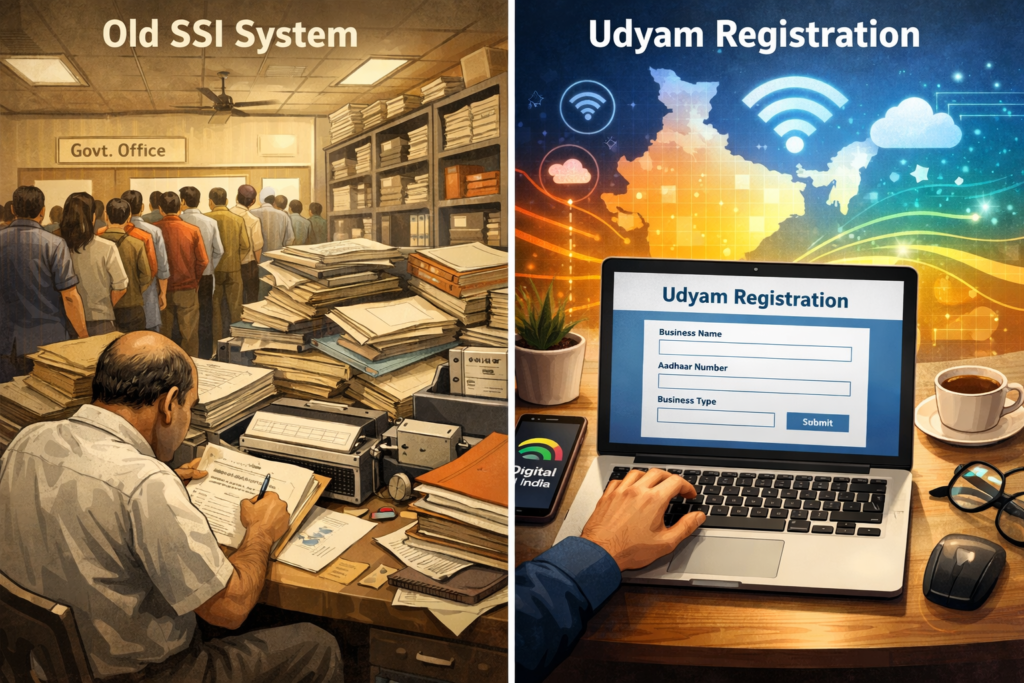
SSI Registration was the old method of registering small-scale industries in India, where businesses had to manually file EM-I and EM-II forms through District Industry Centers (DICs), making the process time-consuming and complicated. To simplify this, the government introduced digital systems like Udyog Aadhaar, which was later replaced by Udyam Registration in 2020.
Today, Udyam is the only valid MSME registration system in India. It is fully online, paperless, and free, based on self-declaration and linked with PAN and GST for automatic data verification. Businesses must migrate to Udyam to continue receiving benefits such as government schemes, subsidies, low-interest loans, tax benefits, and priority in tenders. Eligibility is based on investment and turnover limits, and the process is simple, quick, and designed to support the growth of small businesses.

Barcode Registration
Barcode Registration is the process of obtaining a unique code for your products from GS1 India, based on global standards set by GS1. These barcodes help identify, track, and manage products across retail stores, warehouses, and online platforms.
Although not legally mandatory in India, barcode registration is practically essential for businesses that want to sell on e-commerce platforms, enter large retail chains, or expand internationally. It improves inventory management, reduces manual errors, speeds up billing, and enhances brand credibility.
The process involves applying online through the GS1 India portal, selecting a suitable barcode plan, submitting business documents (like PAN and GST), and paying the required fees. After verification, GS1 assigns a unique company prefix and barcode numbers (GTINs) for your products.
In short, barcode registration is an important step for businesses to ensure smooth operations, better market access, and professional growth.

Foreign Subsidiary Company Registration
A foreign subsidiary in India is an Indian company that is owned and controlled by a foreign parent company, usually holding more than 50% of its shares. Even though the ownership is foreign, the subsidiary is treated as a separate legal Indian entity and must follow local laws like the Companies Act, 2013 and Foreign Exchange Management Act, 1999.
There are two main types: a wholly-owned subsidiary (WOS), where the foreign company owns 100% and has full control, and a joint venture (JV), where ownership and decision-making are shared with an Indian partner. A subsidiary offers key benefits like limited liability (protecting the parent company), full control over operations (in WOS), access to India’s large market and skilled workforce, and tax advantages through Double Tax Avoidance Agreements.
To set up a subsidiary, basic requirements include at least two directors (one Indian resident), two shareholders, and a registered office in India. The process involves getting DSC and DIN, reserving a company name, preparing MoA and AoA, filing the SPICe+ form, and obtaining a Certificate of Incorporation. After registration, the company must complete compliances like opening a bank account, reporting foreign investment to RBI, and filing annual returns.